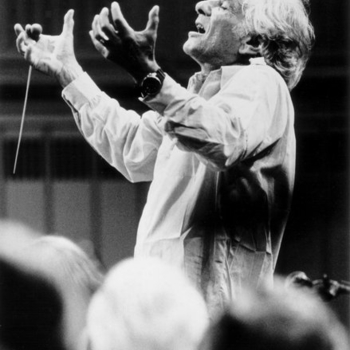
Leonard Bernstein – Brahms: Musical Analysis: Bernstein on Brahms, Symphony No. 4, Op. 98, 1st Movement - IV. "Now, Think of It - We Have So Far Only Had 44 Bars of Music"
Now think of it: we have so far had only 44 bars of music, fairly
Quick bars at that, of only two beats apiece. And in that short
Space, we have already witnessed development of the first theme
Through rhythm, key change, diminution, double diminution
Embroidery, imitation, syncopation - a staggering array
Showing enough inventiveness for a whole symphony. And it is
All still concerned with one theme, the first theme. We are
Now only at the transition section, which will carry us
Forward to a new key in which the second theme will be stated
Now this transition section contains new germinal motives
Significant enough to be called themes in themselves, but more
Important, no sooner do they appear than they are already
Undergoing some kind of development, just as the first theme did
You see, that's what a symphonic mind like Brahms' is like. It
Immediately spots the possibilities in any given group of notes
And exploits them to the hilt, just as a great novelist develops
The possibilities of his characters through every word they utter
Now the first motive of the transition section is based on
A descending scale: which is going to be very important in
Themes to come, as you will see. But as it appears here
It is already developed through the device of a canon. That
Is, it is immediately imitated by another orchestral voice
Now the second motive of the transition section, a kind of tragic
Fanfare: which is also going to figure prominently throughout
The development of the movement. In this fanfare, you may have
Noticed a new rhythm, strongly pronounced and almost balletic
Almost like a tango, isn't it? Well, Brahms now takes this
Rhythmic germ and makes out of it the accompaniment of the next
Transitional theme: And over this strong rhythm, the cellos
And horns sing out a big romantic tune: So that all together
It really does sound like some sort of a huge, mad German tango
Which brings back the fanfare again
Now developed through a change of key
Now taking those last two notes: Brahms builds a whole new section
Out of them using the pizzicato strings and the woodwinds as
Antiphonal choirs: That's real musical architecture, taking the last
Fragment of one section and creating the succeeding one out of it
But what is so special and so typical of this great symphonic mind is
That this new section: is at the same time a development of the very
First theme, which, if you remember, also went in groups of two
Notes: So that when this section occurs, born of
A whole other germ, it automatically, perhaps
Unconsciously, develops the first theme as well
You see how deep the wells of genius are. Everything connects and
Is unified at the deepest level. It is all one, just as the novel
War and Peace, with all its mass of material and events and
Characters, is all one. Now the transition section concludes with
Two restatements of that descending scale we heard before: First
We hear it syncopated in the winds, with the pizzicato strings
Underneath: And then immediately in a dotted rhythm by the strings
Which burst out of their pizzicato chains, released and free
Now this last version of the descending scale is again in
Anticipation of themes to come. It is a shadow cast before the
Coming event, because in the second theme, which is now about to
Be heard, the same scale in the dotted rhythm will be used as an
Integral part of the theme itself, so that, amazingly enough, we
Can say that the second theme has actually been developed even
Before it has been stated. These are the intricacies of the symphonic
Concept, wheels within wheels, all part of one great machine