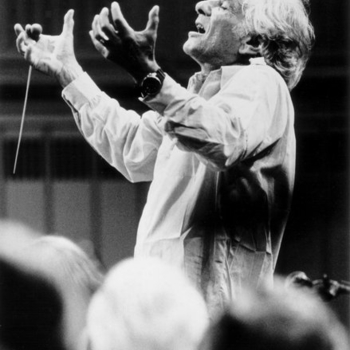
Leonard Bernstein – Brahms: Musical Analysis: Bernstein on Brahms, Symphony No. 4, Op. 98, 1st Movement - VI. "This Brings Us to the Development Section Proper"
This brings us to the development section proper. Now, it seems
Almost redundant to call this the development section, since we
Have had so much development already. No theme or thematic fragment
So far has been stated without being somehow or other developed
And yet now Brahms is ready and eager to plunge into a whole new
Development section in which he will show us still further and deeper
Qualities inhabiting his themes, just as the novelist shows us his
Characters in ever-changing, always new lights. The development

Begins where the exposition left off, treating of the opening theme
We hear it first exactly as it was heard in the opening of the
Movement, as though this were going to be a literal repeat of the
Exposition, as used to be the custom with Mozart and Beethoven
But no, there's the difference. A harmonic difference. Did you hear
The difference? Whereas in the exposition, the harmony was agitated
And passionate, now it is calm and pastoral. This character in the
Novel has undergone a visible change that is further aided by
Diminution. Listen to how the phrase
Becomes compressed and condensed

This compressed phrase now turns into the embroidery of the next
Section, as if by magic. Symphonic sleight of hand, that's what it
Is. And what is it embroidering? Another version of the first theme
In which those famous two-note groups we noted before have
Now expanded into three-note groups. I am sure you can hear
That this is the same theme, whether it goes in groups of
Two notes or three notes. It's only another version of the
Original, an expanded, more abundant version. And coupled with
The embroidery, which is also a flowering of the same branch
We feel a true development, a sense of increase and growth

And now even a further growth through a dynamic
Increase, as the orchestra bursts into a roaring
All-out development of those three-note groups

Now, that's development. Not only in a dynamic sense, but harmonically

, Contrapuntally, rhythmically, dramatically. Also, it's a bit

Complicated. For instance, did you notice that a canon was going on?

A three-note group up high, imitated immediately by a three-note

Group down low, making a canon. But did you notice also that the

Imitation is always a mirror reflection of the thing it's imitating?

If the upper three notes descend, the lower three notes ascend
And vice versa. This is called a canonic inversion, not so difficult
To understand. Simply means a canon where the imitation is upside
Down. And added to all these canonic goings-on, the horns and
Woodwinds are enjoying a canon of their own, based on the embroidery
We heard a moment ago, which was in turn an outgrowth of that
Compressed phrase, remember? Which was in turn a development of
This original germ. As we said before, wheels within wheels. And
This canon too is inverted. While the horns play, the woodwinds
Imitate upside down. But the real development is still to come

Incredible as it seems, Brahms has by no means exhausted the
Potential of those seeds he planted in the exposition. This exciting
Section of canons we just finished lands us in a new area of sudden
Quiet, of an almost mystic stillness, where the fanfare theme has
Been taken away from the brass and given to hushed strings and winds
In an atmosphere no longer of assertiveness, but of eerie suspension
And into this suspended atmosphere, the winds recall the opening
Motive as a two-note group, then as a three-note group, and then
In an even more expanded rhythmic way. On through key after key
This development goes, finally combining with the fanfare itself